

How incorporated business owners can use Health Spending Accounts to cover healthcare costs, save on taxes and offer flexible employee benefits.
Healthcare expenses can add up quickly. Between dental appointments, prescription medications, glasses and other out-of-pocket costs, it's easy to spend thousands of dollars on healthcare each year.
If you're a small business owner, you might have considered setting up health benefits for yourself and your employees. But traditional insurance plans can be expensive, especially for smaller businesses.
The good news is that you don't need a big-company budget to offer healthcare benefits. If you're incorporated, a Health Spending Account (HSA) can be a flexible, tax-efficient way to cover eligible medical expenses for yourself, your family and your employees.
Let's look at how Health Spending Accounts work, how they compare with other options and whether one might make sense for your small business.
Three ways to manage healthcare expenses
If you're an incorporated business owner, there are a few ways to pay for healthcare expenses. Each has different tax implications.
Option 1: Pay out of pocket and claim the Medical Expense Tax Credit
You can pay for eligible medical expenses personally and claim the Medical Expense Tax Credit (METC) on your personal income tax return.
The credit can help offset some of your costs, but it isn't a dollar-for-dollar reimbursement. It also depends on your income and the amount of eligible medical expenses you claim.
For many incorporated business owners, there may be a more tax-efficient option.
Option 2: Buy traditional health insurance
Traditional group benefits can cover a range of healthcare expenses, including dental care, prescriptions, vision care and paramedical services.
The downside? Premiums can be expensive, and costs may increase based on your coverage, claims experience and the size of your team.
For a small business, paying monthly premiums for a traditional benefits plan may not be practical.
Option 3: Set up a Health Spending Account
A Health Spending Account is an arrangement that allows your corporation to reimburse you and eligible employees for qualifying healthcare expenses.
When properly structured and administered, eligible reimbursements are generally tax-free to the recipient and tax-deductible to the corporation.
This means you can pay for eligible personal healthcare expenses through your business rather than withdrawing additional personal income to cover them.
We work with Olympia Benefits, a Canadian Health Spending Account provider, to help make the process straightforward.
Here are a few reasons an HSA may be worth considering.
Why consider a Health Spending Account?
1. Potential tax savings
One of the biggest advantages of an HSA is the potential tax savings.
Let's look at an example.
Imagine you operate an incorporated business with two people and earn $100,000 in annual business income. You have a $3,000 eligible medical expense.
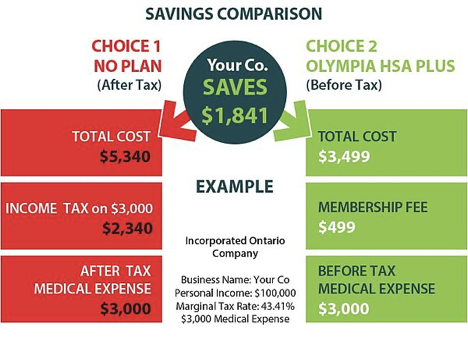
Without an HSA:
You would need to withdraw more than $5,000 from your corporation to have $3,000 available personally after income tax, assuming a marginal tax rate of approximately 43%.
With an HSA:
Your corporation pays the $3,000 eligible medical expense through the HSA, along with Olympia's annual membership fee of $499. The reimbursement is generally tax-free to you and deductible to your corporation.
In this example, you could save close to $2,000 in personal taxes.
Your actual savings will depend on your tax situation, eligible expenses and the fees associated with your HSA.
Want to see how much you could save? Try Olympia's HSA Savings Calculator.
2. Predictable costs and flexibility
Traditional insurance plans typically come with monthly premiums, deductibles and coverage limits.
With Olympia's Health Spending Account, you pay one annual membership fee instead. You can claim eligible expenses up to your available annual allowance, with coverage for eligible dependants.
Olympia offers annual claim allowances of up to $15,000, depending on the plan.
This makes it easier to budget for healthcare costs without committing to an expensive traditional benefits package.
3. Simple administration
Using a Health Spending Account is relatively straightforward.
Here's how it works:
- Pay for an eligible healthcare expense using your personal payment method.
- Upload your receipt through Olympia's online platform.
- Submit your claim for reimbursement.
- Receive your reimbursement tax-free, provided the expense qualifies.
You don't need to manage a complicated insurance policy or pay monthly premiums.
What if you have employees?
Health Spending Accounts aren't just for business owners. They're also a practical way to offer healthcare benefits to a small team.
As the employer, you determine each employee's annual spending allowance. Employees can then submit claims for eligible healthcare expenses up to their available allowance.
Unlike traditional insurance, you generally only pay when an employee submits an eligible claim.
This gives employees flexibility to use their benefits for the healthcare expenses that matter to them, while helping you keep your business's benefit costs predictable.
Is a Health Spending Account right for your business?
An HSA can be a good fit for:
- Incorporated business owners who want to cover eligible personal healthcare expenses more tax-efficiently.
- Professionals who operate through their own corporation.
- Small businesses looking to offer employee benefits without the cost of traditional group insurance.
- Incorporated businesses with fewer than 50 employees.
There are a few important considerations.
You generally need to be incorporated. Sole proprietors can't typically set up an HSA through their unincorporated business.
The arrangement needs to meet CRA requirements. Not every medical expense qualifies, and the plan must be properly structured to receive the intended tax treatment.
Consider your team's needs. Larger businesses may find that traditional group benefits offer better value depending on their workforce and coverage requirements.
Getting started with a Health Spending Account
If you're interested in learning more, Olympia Benefits has a helpful list of 53 frequently asked questions about Health Spending Accounts.
You can also contact Alden Hui at Olympia Benefits at 403-668-1845 to discuss your options.
If you're wondering whether an HSA makes sense for your corporation, we’re here to help. At True North Accounting, we look at the bigger picture, including your business structure, personal tax situation and overall tax strategy.
The right benefits plan can help you cover healthcare expenses, support your employees and make better use of your business income.
Looking for more practical advice? Explore our Small Business Basics resources for information to help you make informed decisions about your business.